
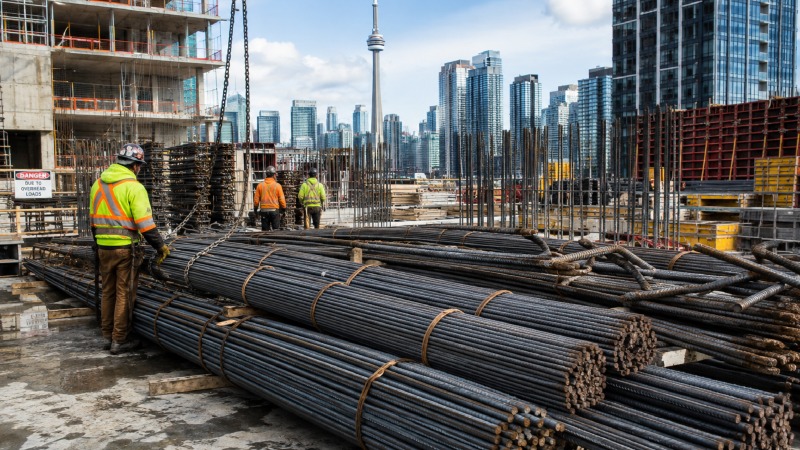
Rebar procurement can have a direct impact on how smoothly reinforced concrete work progresses. For contractors working in Toronto and across the GTA, choosing a supplier involves more than comparing the price of reinforcing steel. Fabrication capacity, material availability, scheduling, delivery coordination, and site access can all affect whether steel arrives when crews are ready to install it.
These considerations become especially important on projects with limited staging space or tightly sequenced concrete pours. Evaluating a supplier before the first major order can help contractors identify potential constraints early and build a more dependable procurement plan.
Match Fabrication Capabilities to Project Requirements
Not every project requires reinforcing steel in standard lengths and straightforward quantities. Structural drawings may call for bars that are cut, bent, bundled, and identified according to specific schedules.
Contractors should therefore assess rebar fabrication capabilities alongside basic material supply. A supplier needs to understand the project’s bar lists and fabrication requirements and have enough capacity to prepare orders within the required timeframe.
Accuracy also matters. Fabrication errors may not become obvious until material reaches the jobsite, where incorrect dimensions or configurations can interfere with installation. Resolving those problems can consume valuable time when formwork, inspections, concrete placement, and other trades are already scheduled.
Before placing substantial orders, contractors can clarify how fabrication information is submitted, how revisions are managed, and how completed material is organized for delivery. These practical details can be just as important as production capacity.
Look Beyond Today’s Material Availability
A supplier having material available today does not necessarily mean it can support a project over several months. Larger concrete projects may require repeated orders with different bar sizes, quantities, and fabrication specifications as construction advances.
Procurement teams should consider whether a concrete reinforcement supplier can maintain access to the materials expected throughout the job. This is particularly relevant when several construction projects are competing for reinforcing steel and other GTA construction materials.
It is useful to discuss anticipated volumes and ordering patterns before work reaches peak demand. Sharing schedules early gives suppliers a clearer picture of upcoming requirements while giving contractors an opportunity to identify possible supply constraints.
Planning does not eliminate every disruption, but it can reduce dependence on last-minute purchasing. It also helps estimators and project managers distinguish between a supplier that can fill an individual order and one that is equipped to support the broader construction schedule.
Treat Delivery as Part of the Construction Schedule
Rebar delivery in Toronto has to work within the realities of an active construction site. Downtown locations may have limited access, restricted unloading areas, traffic constraints, or little room to store material. Even sites outside the core can face challenges when multiple trades and deliveries are competing for space.
For that reason, delivery should be considered part of construction planning rather than a separate purchasing task. Contractors should understand how the supplier coordinates delivery windows, identifies loads, communicates schedule changes, and handles projects requiring multiple shipments.
The sequence of deliveries can matter as much as the arrival time. Sending too much reinforcing steel at once can create storage and handling problems. Sending material too late can leave crews waiting or disrupt planned concrete work.
Clear communication between the project team and supplier helps align fabrication, dispatch, unloading, and installation. This is especially valuable when schedules change, since a revised pour date may affect several related orders.
Consider Local Knowledge and GTA Logistics
Toronto construction presents logistical conditions that can influence material procurement. Congested routes, restricted site access, dense development, and varying travel times across the GTA can all affect how reliably materials move from a fabrication facility to a jobsite.
A Toronto rebar supplier should be evaluated partly on its ability to work within these conditions. Contractors may want to discuss delivery areas, typical scheduling procedures, lead times, and how the supplier coordinates orders for projects with limited receiving windows.
Local sourcing can also simplify communication when drawings change, quantities are adjusted, or additional reinforcing steel is required. The important question is not simply how close a supplier is, but whether its fabrication and delivery processes align with the project’s actual requirements.
For contractors comparing options for a Rebar Supplier Toronto projects can rely on, local service information can provide useful context about material supply, fabrication, delivery coverage, and the types of construction requirements a supplier is equipped to support.
Evaluate Reliability Before Making the Commitment
Price will always be part of supplier selection, but the lowest material cost may not represent the lowest overall project risk. Delayed deliveries, fabrication mistakes, incomplete orders, or poor communication can create costs elsewhere in the construction schedule.
Before committing to a supplier, contractors should consider how orders will move from estimating and fabrication through dispatch and delivery. Questions about lead times, order confirmation, schedule changes, and communication responsibilities can reveal how well a supplier’s processes fit the project.
It can also help to identify who will handle day-to-day coordination. A clear point of contact makes it easier to address revised quantities, drawing updates, delivery changes, and other issues that arise during construction.
Ultimately, supplier reliability is closely connected to project planning. A capable supplier should be able to support the required reinforcing steel specifications while working within the timing and logistical constraints of the job. For Toronto contractors, assessing those capabilities early can make rebar procurement a more predictable part of the construction process.