
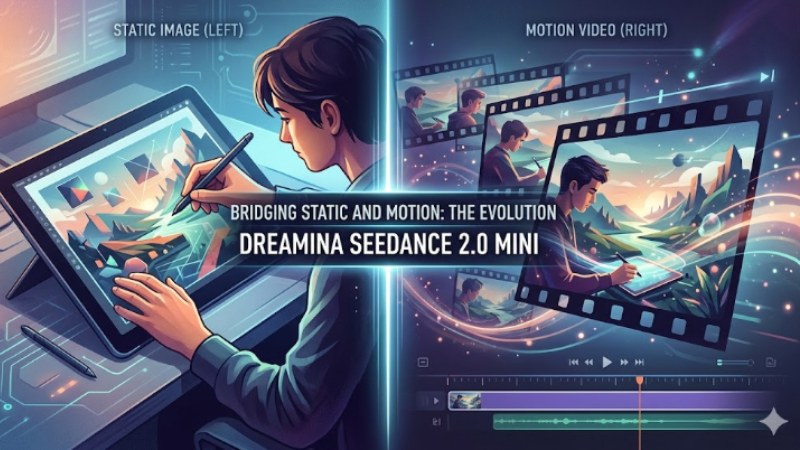
In the rapidly shifting landscape of generative artificial intelligence, the divide between static imagery and dynamic video content is narrowing with unprecedented speed. For content creators, marketers, and digital storytellers, the ability to breathe life into still visuals has moved from a cumbersome post-production task to an instantaneous creative process. The latest development in this space, the Dreamina Seedance 2.0 Mini image to video upgrade, marks a significant shift in how AI-driven tools can be integrated into high-frequency production workflows.
As digital media demands continue to favor short-form, high-engagement video content, the necessity for efficient, high-quality transformation tools has never been greater. By focusing on the refinement of motion synthesis and structural integrity, this iteration of the tool addresses long-standing challenges in generative video: consistency, control, and multi-asset integration.
The Technical Advancement in Motion Synthesis
At its core, the appeal of a refined AI video generator lies in its capacity to interpret the spatial information of a still image and extrapolate logical movement. Previous iterations of AI video models often struggled with “morphing” artifacts—where subjects would distort, dissolve, or blend into backgrounds during movement. The technical improvements within the Dreamina Seedance 2.0 Mini AI video generator focus on temporal consistency, ensuring that the features defined in a static source remain coherent throughout the generated clip.
This update represents a departure from purely stochastic, or random, generation. By leveraging a more sophisticated understanding of image structure and motion kinetics, the system minimizes the need for extensive prompt engineering. It ensures that character movements exhibit realistic physical force and weight, camera transitions feel natural, and subjects remain highly consistent across frames. The model processes detailed prompts with greater accuracy, allowing the user to focus on the creative outcome rather than the technical calibration of the model.
Enhancing Workflow Efficiency for Creators
For professional creators, the value of an AI tool is measured by its integration into existing pipelines. The “Mini” designation within this tool’s architecture is intentional; it is optimized for processing speed, fast iteration, and lowering the computational friction that often plagues high-definition video rendering. In professional content creation, the bottleneck is often the rendering time and the trial-and-error cycle required to achieve a specific motion aesthetic.
By lowering the barrier to entry, the Dreamina Seedance 2.0 Mini image to video feature allows creators to produce high-fidelity motion previews in seconds. It provides a robust, browser-based environment where an asset can be uploaded, prompted, and animated without requiring local high-end hardware. This allows for rapid prototyping of visual concepts, whether for a client pitch, a social media campaign, or a narrative storyboard. The ability to transition from a single uploaded file to a functional video sequence significantly compresses the production lifecycle, allowing creators to allocate more time to strategic storytelling and less time to mechanical processing.
Multimodal Flexibility: Beyond Single-Frame Animation
One of the standout characteristics of this update is its embrace of multimodal inputs. While standard image-to-video tools are traditionally restricted to a single graphic asset, the ecosystem backing the Dreamina Seedance 2.0 Mini supports a more comprehensive array of creative references. Creators can leverage up to 12 clips per project, incorporating multiple images, video clips, and audio tracks to guide the AI.
| Capability | Feature Details | Impact on Workflow |
| Multimodal Inputs | Combines images, text, and audio cues | Allows unified reference control for complex scenes |
| Character IP Locking | Preserves facial and clothing details across frames | Maintains visual identity across diverse environments |
| Frame Interpolation | Smooths out micro-movements automatically | Eliminates choppy transitions and jittery artifacts |
| Audio Alignment | Synchronizes visual rhythm with soundtracks | Matches scene cuts and motion pacing to a beat |
This structural flexibility means a creator can upload a character design as an image reference, describe the desired action via text using the Dreamina Seedance 2.0 Mini text to video capabilities, and even inject an audio track to dictate the clip’s underlying rhythm. The model actively analyzes these concurrent inputs to deliver a 1080p output where the timing, font styles, transitions, and screen rhythm feel intentionally directed rather than randomly compiled.
Practical Applications Across Digital Industries
The utility of these advancements extends across several key sectors, particularly where visual storytelling is the primary driver of digital performance.
1. Marketing and Brand Campaign Acceleration
In digital marketing, the ability to repurpose existing static assets is critical for maintaining a lean budget. Brands often possess vast libraries of high-quality product photography, graphic designs, and lookbooks that remain static. With a specialized image-to-video tool, these assets can be transformed into dynamic video advertisements, cinemagraphs, or social media teasers that capture attention in crowded feeds.
Marketers can rapidly iterate on ad creative based on performance data in real-time, matching product variations with distinct motion styles without organizing entirely new video shoots.
2. Social Media and High-Frequency Content
Social platforms prioritize video-first content, heavily favoring short-form video in their recommendation algorithms. Creators who focus on visual storytelling—ranging from digital artists and illustrators to lifestyle influencers—can animate their artwork or photography to match these platform preferences. Because the model supports rhythmic editing, the generated motion can easily align with music tracks, making it easier to craft engaging short clips for fast-paced digital platforms.
3. Streamlining Pre-visualization and Storyboarding
For film, indie animation, and creative agencies, pre-visualization is an essential but time-consuming phase of production. The platform serves as a vital bridge during this stage, turning static storyboards, sketches, or rough concept art into fluid, cinematic previews. Instead of using static sketches to convey complex camera movements to a client or team, creators can generate short sequences that illustrate intended camera pans, lighting transitions, or character placement, establishing clear alignment before investment is made in full-scale production.
The Role of User-Centric AI Design
The success of modern AI tools hinges on balancing backend power with a frictionless frontend user interface. While advanced deep-learning models often require significant technical oversight, the design philosophy behind this upgrade emphasizes accessibility. By removing the need for complex command-line executions or extensive parameter tuning, the platform encourages experimentation. It bridges the gap between those with traditional video editing expertise and those whose strengths lie primarily in photography, graphic design, or copywriting.
This accessibility does not come at the cost of creative control. As the AI handles the complex motion mathematics and physics simulation, the creator maintains strict ownership over the visual direction. Advanced features, such as “Single-frame” mode—where users can upload both a starting and an ending frame to guide the AI’s trajectory—give creators precise control over how a scene unfolds, ensuring the output closely matches their original intent.
Looking Toward the Future of Generative Media
As we look toward the trajectory of generative AI, the distinction between manual editing and automated generation will continue to evolve. Tools like the Dreamina Seedance 2.0 Mini image to video engine are not designed to replace human ingenuity, but rather to serve as force multipliers. They provide the foundational infrastructure for rapid iteration and high-quality output, allowing human creators to focus on the conceptual, narrative, and strategic elements of their work.
The transition toward AI-augmented production is a fundamental structural shift in how digital content is produced at scale. As these models continue to mature, the industry will likely see even deeper integration across post-production environments, offering cleaner style transfers, localized visual FX replication, and hyper-realistic physics rendering. For now, this version delivers a balanced, practical solution that introduces reliable, high-fidelity motion into the modern creator’s daily digital toolkit.
Media Contact:
For further information, media inquiries, or interview requests regarding recent model updates, please contact:
- Contact Person: Ming Hu
- Email: capcutweb@bytedance.com
- Company Name: CapCut