
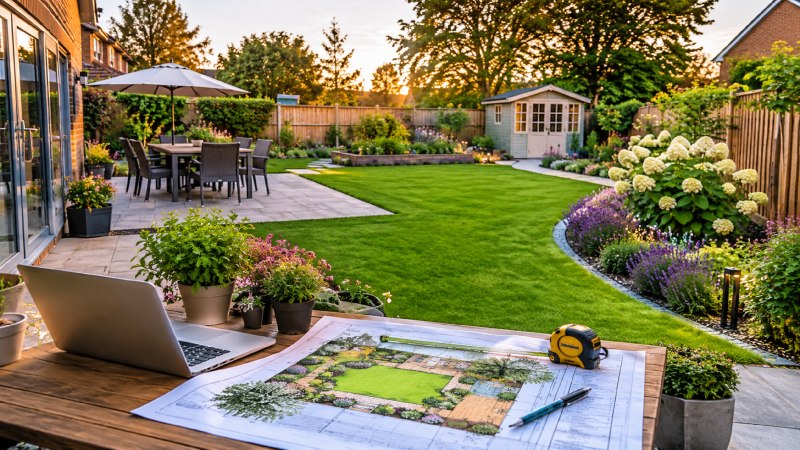
Last spring, your neighbour spent a full Saturday afternoon rearranging the same three pots across his patio like a man solving a Rubik’s Cube he’d never finish.
By Sunday evening, he’d dug up a perfectly healthy rose bush, replanted it in full shade, and somehow managed to block his own garden gate with a pile of decorative gravel.
Most garden disasters don’t start with bad plants or bad weather. They start with no plan at all. Here’s how to map out your outdoor space properly before the first shovel hits dirt.
Audit Your Soil and Sunlight First
Every garden has some quirks, and you need to figure out what yours is before you spend a penny on plants. Walk the space at three different times during the day and note which areas actually get direct sunlight and which ones sit in shade.
That south-facing wall might bake in six hours of summer heat, while the patch behind your shed stays permanently dark and damp.
Putting a sun-loving Mediterranean lavender in that corner is the garden equivalent of paying top dollar for a penthouse view and getting a basement window facing a brick wall.
Grab a handful of soil and give it a squeeze. If it clumps into a sticky ball, you’re dealing with heavy clay. If it crumbles through your fingers like dry sand, you’ll need to bulk it up with organic matter before anything takes root.
Clay drains slowly and stays cold longer in spring, which delays planting by weeks. Sandy soil loses moisture and nutrients fast, so anything you plant will need feeding more often.
Knowing which one you have saves you from watching expensive shrubs slowly yellow and wither.
Design the Layout
A garden without defined areas will turn into a free-for-all where the barbecue grill, the kids’ trampoline, and your delicate hydrangeas all compete for the same patch of ground.
Think about how you and your family move through the space. You want a clear route from the back door to the seating area that doesn’t involve stepping over flower beds or dodging a water feature.
If guests have to navigate an obstacle course to reach the grill, your layout needs rethinking.
Map out a few distinct areas: a paved spot for cooking and eating, a patch of lawn for the kids or dog, a planted border for colour, and a tucked-away corner for the bins and compost.
Each area should have a clear purpose, and the boundaries between them should feel natural.
Stepping stones, gravel paths, and low hedging all work well for separating those areas without making your garden feel boxed in. A change in surface material is usually enough to tell people where to walk and where to stay off.
Map Out the Hardscaping Before Picking Any Plants
Paths, patios, retaining walls, and drainage channels are the bones of your garden, and they need to go in first. Getting the hard structures right before you plant anything will save you from watching heavy machinery flatten your fresh blooms into expensive floral mulch.
Anchor the space first with your main patio or deck. From there, plot out logical pathways that connect your key spots.
Every path needs a real destination, because nobody wants to stroll down a brick walkway that abruptly dead-ends into a fence or loops aimlessly like a miniature race track.
Check where water runs after a heavy downpour. If it pools against the back wall or floods the centre of your lawn, you’ll need drainage sorted before you try anything else.
A French drain or a simple gravel channel can redirect water away from your foundations and stop the garden from turning into a swamp every November.
And before you dig anything, find out where your underground utilities run. Hitting a water main with a pickaxe is not the kind of weekend adventure you want to explain to the neighbours.
Pick Plants with a Long-Term Growth Strategy
That innocent-looking shrub in the tiny pot seems harmless today. Give it two years, though, and it’ll be spilling over your walkway, blocking your front door, and claiming your patio as its own.
Always check the mature height and spread before you buy. If the tag says “grows to 3 metres,” believe it—it won’t politely stop expanding just because you run out of border space.
To avoid a flat green wall, layer your beds in three distinct rows:
- Tall structural plants and dwarf trees for height and privacy;
- Mid-sized perennials to pack in bulk and colour;
- Low ground cover and spreading herbs to soften the edges.
Finally, make sure to mix in spring bulbs, summer bloomers, autumn foliage, and winter evergreens. Otherwise, you’re paying full price for a garden that only looks decent for one month out of twelve.
Know When to Call In the Professionals
There’s absolutely no shame in admitting that your ambition has outgrown your toolkit. Complex grading, structural retaining walls, integrated lighting, and long-term planting schemes all require expertise that a weekend and a YouTube tutorial won’t cover.
Professional garden designers will assess every angle, slope, drainage run, and soil condition before drawing up a plan. They’ll factor in mature plant sizes, seasonal light patterns, and local growing conditions that most homeowners overlook entirely.
If your project involves anything more complex than a few new borders and a compost bag, tapping into expert garden planning from qualified designers will save you thousands.
You’ll get a layout that accounts for every slope, shadow, and drainage issue your garden actually has.
And while they handle the digging, the drainage, and the stubborn tree roots, you get to sit inside with a cup of tea and watch the whole thing come together without spending your weekend covered in mud and regret.
Conclusion
Congratulations on choosing the blueprint over the impulse buy. You’ve now sidestepped a weekend full of digging holes in the wrong spots, watching expensive shrubs wilt within two weeks, and explaining to the neighbours why your patio slopes to the left.
Now grab a pencil, sketch that layout, and get ready to enjoy a garden that’s ready for October.