
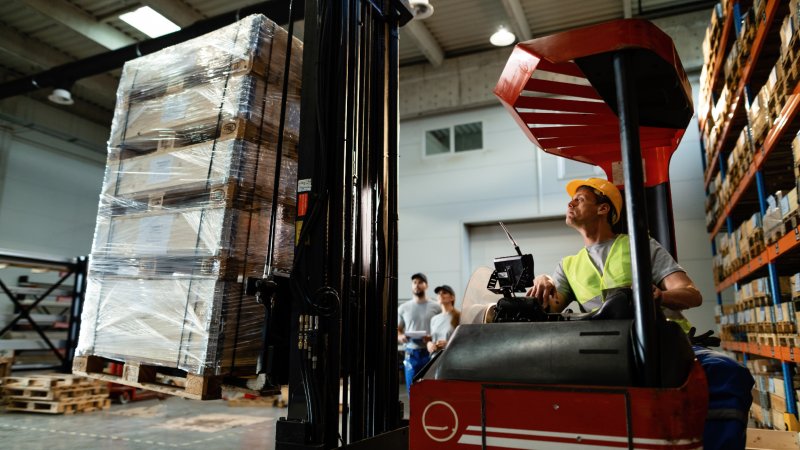
In a perfect world, every jobsite would be flat, every load would be light, and every shelf would be within arm’s reach… But the world of industrial logistics is rarely ever perfect.
In reality, most operations deal with narrow aisles, unstable surfaces, heavy materials, and deadlines that never wait, and teams need systems that absorb pressure, adapt quickly, and keep workflows moving constantly, even when the environment refuses to cooperate.
In these situations, ‘close enough’ is almost always a recipe for downtime. As such, to maintain a high-volume flow, you need a machine that treats a three-ton load at full extension with the same delicate precision a surgeon uses with a scalpel. Material handlers have evolved to be exactly that… the primary problem solvers of the industrial yard. They are the critical asset in any fleet that’s designed to reach over obstacles rather than around them, so that no fences, trenches, or mud pits will ever dictate the pace of your project.
The Long Arm of Productivity
Most equipment is bound by the path directly in front of it. As such, a truly versatile fleet must master the entire volume of the jobsite. It’s the difference between having a tool that works in a straight line and a system that masters the space around it.
In general, success in industrial logistics is found at the intersection of two critical variables…. that is tempo and access. You need the speed to move volume, but you need the reach to bypass obstacles. This is where the ‘Long Arm of Productivity’ comes into play. A strategic philosophy that pairs the surgical, rapid-fire pace of the forklift with the go-anywhere reach of the telehandler. Together, they form a dual-threat system that maximizes both efficiency and flexibility in material handling for any project.
The forklift acts as the workflow accelerator on flat, predictable surfaces. It serves as one of the most efficient ways to move pallets from point A to point B without breaking a sweat. However, when the environment becomes unpredictable, the telehandler provides the necessary access by picking up where the forklift’s vertical mast reaches its mechanical limit, offering a forward reach that allows a site to breathe. Combined, they reduce logistical friction to nearly zero.
The Multi-Tools of the Modern Fleet
When you look at the operational blueprint of a successful project, the material loaders are the components that hold the whole structure together. They are called multi-tools due to them being simply too versatile to be stuck doing one job.
With a quick change of an attachment or a shift in terrain, these machines transition from simple movers to strategic placers. Simply put, they provide a range of utilities that allow a single operator to do the work of three different machines without ever exiting the machine in the first place.
The Forklift
The forklift is basically the surgical scalpel of the logistics world, engineered for high-tempo, high-precision cycles where floor space is tight and the clock is ticking. Manufacturers power forklifts with responsive diesel engines and smooth powershift transmissions. These machines deliver consistent torque to move pallets and containers through narrow warehouse aisles and busy loading docks. Operators can also use optional features such as automatic fork leveling and hydrostatic power steering to improve control and precision.Working inside a shipping container or navigating a paved yard at speeds up to 19 km/h, the forklift is the king of ground-level throughput and rapid-fire stacking.
The Telehandler
Where a forklift’s journey ends at the edge of pavement, a telehandler begins its mission. It handles heavy, high, and hard-to-reach tasks with ease.Engineers design the telehandler on a foundation of permanent four-wheel drive and all-terrain steering, allowing it to carry around 4-ton loads across mud, gravel, and uneven terrain that would stop a standard lift instantly.Its true power lies in its telescopic boom, which reaches over 16 meters and places materials onto upper-floor balconies or across deep trenches with precision.Operators can also equip telehandlers with stabilizers for steady lifting and hydraulic cushioning for smoother control, allowing the machine to function as both a mobile crane and a rough-terrain loader.This makes the telehandler an essential asset for any operation that needs to move bulk material not only across a site but also into elevated work zones.Strategic fleet managers know that sourcing the right material handlers for sale remains the most direct strategy to reduce idle time and maximize the utility of every machine in your yard.
The Hidden Cost of Unverified Equipment
In the long run, the cheapest machine on the lot usually ends up being the most expensive one on the jobsite. As such, when a machine shows up with sluggish hydraulics or a boom that shudders under load, the whole project loses its rhythm and goes into a stall. You lose precious time required to hit deadlines, and your operators end up losing control of the controls instead of mastering the task at hand.
A material handler might look solid on a spec sheet, but that means nothing without a deep dive into its mechanical condition, else you’re gambling on the internal health of the asset. An unverified hydraulic cushioning system or inconsistent load-sensing steering creates a trust gap in the cab. If an operator doesn’t trust the machine’s response while hoisting four tons to a 16-meter height, they’ll back off the throttle, and that hesitation doubles cycle times and bleeds profit every single hour the engine is running.
Eliminating these invisible expenses requires moving past the fresh coat of paint. A rigorous 75+ point inspection, covering everything from engine compression to control sensitivity, should be the baseline for any fleet addition. Insisting on a vetting process that includes 360° operational videos and oil analysis, you can have peace of mind knowing the machine’s feel is as sharp as its specs, as verifying the mechanical integrity of your gear is the only way to keep the backbone of the operation strong and the hidden costs at zero.
Of course, the most effective way to eliminate guesswork in a purchase is to use a platform like Makana.com, where every unit includes a rigorous 75-point health report.