
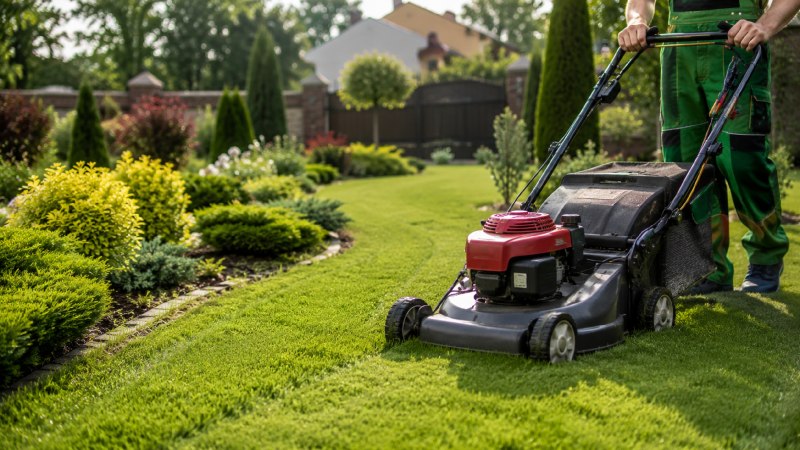
You’ve done everything by the book this year, or at least you thought you did. You mowed on a strict schedule, put down fertiliser twice, and even had a serious chat with the bloke at the garden centre about moss.
Yet, despite your best efforts, your grass still looks like it has completely given up on life by mid-August.
So, before you repeat the cycle, keep reading, because most lawn disasters start with the same five mistakes.
1. Mowing Your Grass Too Short
It sounds entirely logical on paper: cut the grass down to the absolute bone, and you won’t have to think about mowing for a while. Unfortunately, your lawn won’t thank you for it.
When you scalp the grass down to the soil, you remove the leaf surface it needs to photosynthesise. That weakens the roots, thins out the turf, and leaves bare patches where weeds are more than happy to move in.
Shorter grass also dries out faster, which is a real problem during those unpredictable British summers where a heatwave and a downpour can happen in the same afternoon.
Without enough leaf cover to shade the soil, moisture evaporates quickly, and the roots struggle to find water.
Here’s the golden rule: never take off more than a third of the grass height in a single cut and aim to keep your lawn around 3–4 centimetres high. This gives it enough leaf growth to stay strong and enough density to crowd out weeds.
If you’re after more detailed lawn mowing tips, most gardening services recommend adjusting your cutting height seasonally instead of sticking to one setting year-round.
2. Neglecting Soil Health
Mowing is only part of the story. To understand what’s holding your lawn back, you need to look below the surface.
Compacted soil is one of the biggest silent killers of healthy turf. If your garden gets a lot of foot traffic, the ground underneath gradually squeezes together until water and air can barely get through.
Grass roots desperately need both. When they don’t get them, you end up with shallow roots, terrible drainage, and that spongy, waterlogged feeling after every rain shower.
Don’t worry, though. The fix is simpler than most people expect. Just aerate your lawn once or twice a year, ideally in autumn or spring, to open up the soil and let your grass breathe again.
For the best results, you can use a garden fork for smaller patches or rent a hollow-tine aerator for larger areas.
Just think about it. You can spend years treating every symptom on the surface, or you can sort out the soil once and watch half those problems disappear on their own.
3. Relying on Chemical Treatments
The moment a patch of moss creeps in or a dandelion pops up overnight, it’s tempting to grab the strongest chemical treatment available. Garden centres are packed with bottles making bold, miraculous promises, and it’s easy to fall for them.
But here’s what tends to happen: you spray the weed killer, the weeds die, and then they come back. That’s because most chemical treatments deal with what you can see, not the root cause.
Moss, for instance, usually shows up because the soil is too acidic, too compacted, or too shaded. Kill it without fixing the underlying problem, and it’ll be back with a vengeance before you know it.
Overusing fertilisers creates its own issues, too. Too much nitrogen forces rapid growth that looks lush for a few weeks and then becomes weak and disease-prone. Also, it can easily scorch the grass during a dry spell, leaving you with bright brown patches.
So, what can you do? Treat chemicals as a last resort. Test your soil’s pH, improve drainage where it’s poor, and let your lawn recover naturally before reaching for harsh formulas.
4. Ignoring Seasonal Changes
Your lawn isn’t a plastic mat, and it certainly doesn’t need the same treatment in July that it craved back in March. But a surprising number of homeowners stick to the exact same routine regardless of the month, and then wonder why everything goes downhill around October.
To get the best out of your lawn, follow this schedule:
- This is when the grass wakes up hungry. A good feed in late March or April will give it the nutrients it needs to thicken up after winter.
- Focus entirely on hydration without going overboard. Water early in the morning before the heat evaporates most of it.
- This is the time to aerate, throw down seed on thin patches, and apply a specialised autumn feed to toughen up the roots before the frost hits.
- Stay off the grass when it’s frozen and resist the urge to tidy up.
5. Using the Wrong Equipment
You can do everything else right and still end up frustrated if your tools aren’t right for the job.
For example, dull blades don’t cut grass cleanly; they violently rip it. That leaves ragged, frayed edges that turn a sickly brown, invite disease, and make your entire garden look dull, no matter how much love you pour into it.
Taking 20 minutes to sharpen your mower blades at least once a season will make a big difference and save you months of troubleshooting later.
You should also invest in a decent spreader for fertiliser, a spring-tine rake for clearing thatch, and a good pair of edging shears for clean borders. Cheap tools tend to break at the wrong moment, usually halfway through a job on the only dry Saturday you’ve had all month.
You don’t need to spend a fortune. But trust us, buying quality tools from the get-go is usually more cost-effective than replacing flimsy ones every season.
Conclusion
At the end of the day, most lawn care regrets come down to doing a bit too much of the wrong thing or ignoring the basics altogether.
Luckily, none of this damage is permanent. So, try out our hacks and give your lawn a fair chance this year. It’s been trying its best; it just needs you to meet it halfway.