
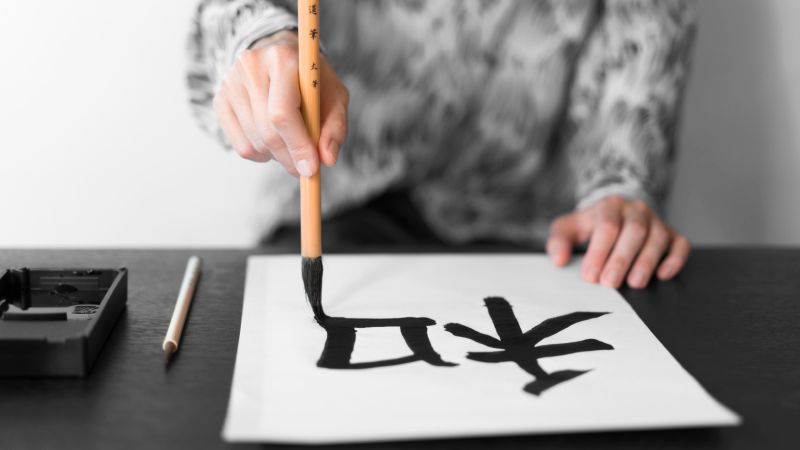
Chinese calligraphy shūfǎ (书法) in Chinese, and they recognize it as one of the oldest continuously practiced art forms in the world. At its most basic level, it involves writing Chinese characters with a brush, but in practice, it represents far more than a writing system. Historically, people in China have understood it as a direct expression of the practitioner’s character, intellectual cultivation, and moral seriousness. In imperial China, society regarded a person’s calligraphy as a primary indicator of their education and inner qualities, and people considered the ability to write well just as important a mark of cultivation as poetry or classical scholarship.If you learn with an online Chinese teacher, they may have told you about its importance at one point.
Chinese calligraphy as a discipline is built around five major script styles:
- Seal script (zhuànshū) is the oldest script, which developed from the bronze inscriptions of the Shang and Zhou dynasties, and the Qin emperor later standardised it as the first unified writing system across Chinese territories. It features uniform stroke width, a highly symmetrical structure, and a visual quality closer to pictographic origins than later scripts. Today, people rarely use it in ordinary writing, but calligraphers still practice it as a living tradition, and they use it as the standard script for personal seals and official chops.
- Clerical script (lìshū) developed during the Han dynasty as a more practical alternative to seal script. Its strokes are flatter and more horizontal, with a characteristic flaring at the end of certain strokes that gives the script a distinctive visual rhythm. Clerical script represents a significant transition in the history of Chinese writing, as it introduced many of the structural features that characterise the scripts that followed. Regular script (kǎishū), which developed during the Wei and Jin dynasties and reached its classical form in the Tang, is the basis of modern printed Chinese characters. It is the script taught to children in school and used as the standard reference form for character learning.
- Running script (xíngshū) and cursive script (cǎoshū) represent progressive degrees of simplification and speed. In running script, strokes within a character are joined and abbreviated but remain largely legible to a reader familiar with regular script. In cursive script, the degree of abbreviation is extreme, with entire characters reduced to a few fluid strokes and legibility requiring specialist knowledge. Cursive script is the most demanding and most expressive of the five styles, and the historical masterworks of Chinese calligraphy are predominantly in running or cursive script. People regard Wang Xizhi, a Jin dynasty official whose work represents the pinnacle of the running script tradition, as the greatest calligrapher in Chinese history. Although none of his original works survive, later admirers preserved his compositions through rubbings and copies, including Emperor Taizong of Tang, who is said to have been buried with a copy of his most celebrated work.
The tools of calligraphy are collectively known as the Four Treasures of the Study (wén fáng sì bǎo) and include the brush, ink, paper and inkstone. The brush is made from animal hair, most commonly rabbit, goat or weasel, bound into a wooden or bamboo handle. Different hair types produce different qualities of line, and the selection of a brush is itself a matter of considerable technical knowledge. Ink is traditionally prepared by grinding an ink stick against a wetted inkstone, a process that requires patience and produces an ink whose consistency the calligrapher controls directly. The quality of the inkstone, the hardness of the ink stick and the fineness of the grinding all affect the resulting ink and, consequently, the character of the brushwork. Then, paper for calligraphy is most commonly xuan paper, produced in Anhui province from a combination of bark fibre and rice straw. Its absorbency and texture produce the characteristic bleeding and feathering of ink at stroke edges that is considered aesthetically essential to serious calligraphy practice. The interaction between brush, ink and paper is not merely technical. It is, in the understanding of the tradition, where the calligrapher’s inner state becomes visible. A tense or distracted practitioner produces strokes that reflect that tension. A practitioner who has achieved a state of focused calm produces work whose quality is understood to derive from that state as much as from technical skill.
In contemporary China, calligraphy occupies a complex position. It is taught in schools as part of the national curriculum, promoted by cultural institutions as a form of intangible heritage, and practised seriously by a substantial community of dedicated artists and scholars. At the same time, digital communication has removed the practical necessity of handwriting from most areas of life, and the proportion of the population that writes characters by hand with any regularity has declined considerably. This tension between institutional promotion and practical marginalisation is a recurring theme in discussions of calligraphy’s future within China.
For students of Mandarin, writing characters by hand, with attention to stroke order and structure, produces a depth of character recognition that typing or passive reading does not. Some teaching institutions such as GoEast Mandarin in Shanghai will use this approach to character learning, treating the physical act of writing as a component of genuine literacy.Researchers generally acknowledge that students who engage seriously with character writing, even without aspiring to calligraphic skill, demonstrate stronger reading comprehension and character retention than those who rely exclusively on digital input methods.